
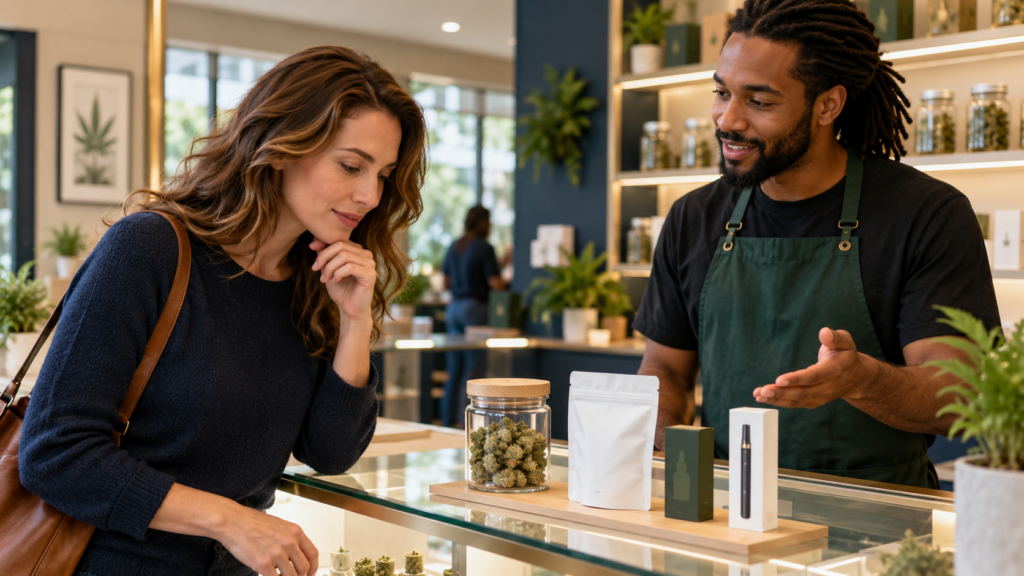
What is cannabis? Cannabis is a plant that contains many natural compounds, including THC and CBD. People may find it as flower, pre-rolls, vapes, edibles, drinks, concentrates, tinctures, or topicals. Some products can cause a high. Effects and risks can change by product, amount, and person.
The short answer to what is cannabis begins with the Cannabis sativa L. plant. The dried flowers, leaves, stems, and seeds may be called cannabis or marijuana. Finished products can also use oils or extracts made from the plant.
The plant contains compounds called cannabinoids. Scientists have found many cannabinoids, but THC and CBD are the best known. Cannabis also contains scent compounds called terpenes and other plant parts.
No single compound tells the full story. The amount, mix, product form, and person all matter. That is why two products from the same plant type may not feel the same.
THC is short for tetrahydrocannabinol. Delta-9 THC is the main form linked with the cannabis high. It may change mood, thought, memory, balance, and reaction time. A larger amount can raise the chance of a very strong or unwanted effect.
CBD is short for cannabidiol. It does not cause the same high as THC. Still, CBD is not risk free, and scientists are still learning about it. Some products marked CBD may also contain THC.
The National Institute on Drug Abuse cannabis guide explains that cannabis contains many cannabinoids and that THC has intoxicating effects. This helps answer what is cannabis without treating every product as the same.
Flower is the dried part of the plant. People may smoke it or use it in a dry herb device. Pre-rolls contain ground flower in ready-made paper. Smoke can harm lung tissue, so inhaled use has health risks.
Vapes heat cannabis oil or other material so a person can breathe in an aerosol. Concentrates contain a higher level of plant compounds and may have very high THC. High-potency products may raise the chance of unwanted effects.
Edibles and drinks contain cannabis that is swallowed. They often take longer to work than inhaled products. A person may take too much if they do not wait. Tinctures are liquid products with label directions. Topicals are placed on the skin and can have different ingredients.
The form changes timing, serving size, and risk. Learn the product form before choosing an item.
Cannabis does not affect everyone in the same way. A product with THC may change the senses, mood, thinking, memory, balance, or reaction time. Some people may feel an effect they do not like. Other people may feel little from the same amount.
Past use, food, other substances, product strength, and setting may play a part. Mixing cannabis with alcohol may increase impairment. Do not assume that a label such as sativa, indica, or hybrid can predict an exact result.
The CDC cannabis health page lists risks tied to brain function, driving, lungs, mental health, and accidental poisoning. Cannabis is not a replacement for care from a licensed health professional.
Inhaled cannabis may be felt within minutes. An edible or drink may take much longer. The New York Office of Cannabis Management says an edible can take up to four hours to reach its peak effect.
Waiting matters. Taking a second serving too soon may cause an unwanted result. New York uses the phrase start low and go slow. This means begin with a low amount and wait before taking more.
When someone asks what is cannabis, timing should be part of the answer. A slow product is not a weak product. Read the package and follow the serving directions.
A regulated label should help an adult see what is in the package. Check the product name, total THC and CBD, amount per serving, number of servings, ingredients, warnings, lot details, and storage directions.
New York products also include a universal cannabis symbol and a link or QR code for a Certificate of Analysis. The lab record gives test details for that batch. The New York consumer guide explains how the store sign, product symbol, and lab link help a shopper spot regulated items.
Do not buy a product only because the package looks bright or makes a broad claim. Use the facts on the label.
Adult-use cannabis is for people age 21 and older. A valid government-issued photo ID is needed to buy from a licensed adult-use dispensary. New York allows an adult 21 or older to possess up to 3 ounces of cannabis and 24 grams of concentrate.
Legal possession does not mean cannabis can be used anywhere. It cannot be used in a car, even if the car is parked. It is illegal to drive while impaired. It is also illegal to take cannabis across a state or country border.
The New York adult-use information page lists current possession, use, vehicle, and border rules. These facts are a key part of what is cannabis in a legal New York market.
Licensed New York dispensaries sell regulated products that must meet state rules for testing and labels. The store should show a state verification sign. The package should carry the New York universal symbol and a way to view the lab record.
Terminal 420 is a licensed adult-use dispensary in Rosedale, Queens. Our license number is OCM-RETL-25-000269. Adults can browse our live Rosedale menu for flower, pre-rolls, vapes, concentrates, edibles, beverages, tinctures, and topicals.
Stock can change. Check the live menu for current choices. Our staff can explain product forms and label facts, but no one can promise how a product will affect you.
Keep every product in its original, closed package. Put it in a locked place that children and pets cannot see or reach. Edibles can look like common food, so safe storage is very important.
Do not leave cannabis in a hot car or an open hotel room. Follow the label. If a child or pet may have eaten cannabis, get urgent help. In the United States, Poison Control can be reached at 1-800-222-1222. Call 911 for an emergency.
Safe storage protects the people and pets who share the space.
The words are often used for the same plant material, but cannabis is the wider plant term. Marijuana is commonly used for cannabis that contains enough THC to cause a high. Hemp is also cannabis, but federal law defines hemp by a low delta-9 THC level on a dry-weight basis.
Some prescription drugs contain a cannabis-derived or cannabis-related compound, but retail adult-use cannabis is not an FDA-approved treatment for a disease. The FDA cannabis information page says the agency has not approved the cannabis plant to treat any disease. Talk with a licensed health professional about medical questions.
Yes. Some people develop cannabis use disorder, which can make it hard to control use. Risk is higher for people who start young or use often. Anyone worried about their use can speak with a licensed health professional.
No. Cannabis cannot be moved across state lines, even when it is legal in the other state. The same warning applies to country borders. Do not put cannabis in a car, carry-on, checked bag, or other luggage for a trip across a border.
Now that you can answer what is cannabis, use our contact and visit page to plan a stop in Rosedale or review the live menu before you go. Bring valid ID showing you are 21 or older.